China has launched a one-year nationwide campaign starting from July to deepen its crackdown on organized crime based on new trends and characteristics, and focusing on those involved in illegal resource control and local bullies, as well as those cyber gang crimes, CCTV News reported on Sunday.
The special campaign will focus on “village bullies,” “township bullies,” “sand bullies,” “mining bullies,” “street bullies,” and “market bullies.” It will also involve strict legal actions against criminal gangs involved in drug production and trafficking, illegal gambling operations, prostitution-related crimes, as well as crimes committed through collusion between domestic and overseas criminal forces.
The campaign will also take strict measures against criminal gangs that manipulate or control minors to commit illegal acts and crimes, and those that infringe upon the rights and interests of minors.
The campaign will also target organized crimes conducted through online platforms and “soft violence” tactics, including online blackmail, illegal lending, extortion, forced consumption, and harassment-based crimes.
China reported record-low crime levels in 2025, with criminal cases down 12.8 percent and homicides down 8.7 percent year on year. Public satisfaction with the anti-organized crime campaign reached 94.55 percent, while the national public security satisfaction rate stood at 98.23 percent, staying above 98 percent for six consecutive years, per official data.
Despite significant progress in the regularized anti-organized crime campaign, the Commission for Political and Legal Affairs of the CPC Central Committee said such crimes remain persistent and complex, with some groups adopting more covert methods, which requires continued and stronger efforts to combat them.
With the rapid development of information technology, organized crime is increasingly merging with cybercrime, with criminal groups shifting from offline to online, overt to covert, violent to "soft violence," and expanding into non-traditional sectors and emerging industries.
The authorities have vowed to continue advancing the campaign against organized crime alongside efforts to root out its “protective umbrellas” and dismantle the protective networks behind it. A faster mechanism will be established to timely investigate corruption, official protection, and collusive networks linked to organized crime. Every such case uncovered will be investigated and dealt with. Greater supervisory efforts will also be devoted to major cases involving long-term ties between organized crime and corruption.
A Gravity-1 carrier rocket carrying nine satellites blasts off from waters off the coast of Shanghai, East China, on July 22, 2026. This flight marks Gravity-1's first open-sea launch and China's first commercial sea-based launch in the East China Sea off the Yangtze River Delta. Photo: Xinhua
This might be the scene you never would have expected to see in a milk tea shop: A delivery rider climbed onto a platform, held up a poster featuring five animated male characters and then called out each character's name and distinguishing features to fellow couriers, warning them not to mix up the merchandise.
According to staff, the store was producing several thousand cups of milk tea throughout the day. Similar scenes have unfolded at the brand's outlets across China, all triggered by a collaboration with an otome game, whose loyal players rush to collect limited-edition merchandise featuring their favorite virtual companions.
The frenzy reflects the extraordinary popularity of otome games - romance simulation titles normally designed primarily for adult women that involve borderline provocative content - which have attracted millions of players both in China and overseas in recent years. But as the genre continues to expand, society is becoming concerned that minors are gaining easy access to games officially labeled "18+," often by bypassing real-name verification or purchasing pre-verified adult accounts online. Age restrictions circumvented
The word otome means "young woman" or "maiden." Otome games place female players at the center of the narrative, allowing them to build romantic relationships and emotional connections with carefully crafted male characters through interactive storytelling. Emotional immersion and relationship-building are at the heart of the genre's appeal.
For Wang Meng, a 25-year-old student in Beijing, the shift from Japanese otome games to Chinese titles felt natural. "Chinese otome games offer a much stronger sense of immersion because there is no cultural or language barrier," Wang told the Global Times.
"Advances in technologies such as 3D graphics also make the experience much more realistic. They fulfill a kind of fantasy about ideal emotional relationships."
Li Baile, a senior student at Chongqing Normal University, said she was initially drawn to the genre by its character development and interactive storytelling.
"Many adult female players value the well-developed characters and the emotional experience they provide," Li told the Global Times. "The sense of companionship is a major attraction."
Yet that emotional appeal has increasingly reached younger audiences, raising concerns over minors' access to such games.
According to state broadcaster CCTV News, a 13-year-old girl in Ningbo, East China's Zhejiang Province, became hooked on an otome game after seeing promotional videos on short-video platforms in September 2025. Although the game required users to be at least 18 years old, she secretly used her mother's identity card to complete the real-name registration.
The unauthorized registration was only the beginning. Over the next three months, the girl spent more than 7,000 yuan ($1033.93) on in-game purchases. After her mother discovered the spending and recovered the account, the teenager simply bought a pre-registered account online and continued playing.
According to her mother, the girl's total spending on the game and related merchandise eventually approached 30,000 yuan. To avoid parental supervision, she secretly purchased another mobile phone and often stayed up until one or two o'clock in the morning playing the game, seriously affecting both her studies and her health.
Although most otome games explicitly identify themselves as "for adults aged 18 and above" and require real-name registration, these safeguards often prove ineffective in practice.
Searches on major Chinese e-commerce platforms reveal a thriving market for so-called "pre-registered accounts" that have already completed identity verification and often contain advanced game progress and rare collectible items. Prices range from hundreds of yuan to thousands of yuan.
Many sellers advertise instant account transfers and even guarantee compensation if the account is reclaimed or banned. When asked whether minors could use these accounts, some sellers responded vaguely, only emphasizing that they could change the account's registered identity information, while others openly stated that buyers' ages would not be verified. As a result, although game developers have established an 18-year-old threshold, the widespread online trade in verified accounts continues to undermine the effectiveness of real-name authentication.
Finding a balance
For adult players, spending money on randomized in-game draws often reflects emotional attachment to virtual characters. Most adults are able to manage those relationships rationally. For minors, however, the same monetization mechanisms can become highly addictive.
"Otome games are clearly unsuitable for minors," Li said. "Their cognitive development is still incomplete, and the games' spending mechanisms can easily encourage impulsive purchases among young people who have no independent financial means."
Wang said she understands parents' concerns but believes that weak enforcement of anti-addiction measures, coupled with insufficient parental supervision, remains the core problem. She argued that game developers should shoulder greater responsibility by adopting stricter verification measures, including upgraded facial recognition systems, while taking stronger action against the illegal trade in pre-registered accounts.
Wu, an industry practitioner based in Shanghai, however, told the Global Times that technology alone cannot solve the problem. "Identity theft by minors and the resale of verified accounts on e-commerce platforms are challenges facing the entire industry as well as regulators," Wu said.
"It is difficult for game companies to eliminate these loopholes on their own."
Zhang Linghan, dean of the Institute of Artificial Intelligence Law of China University of Political Science and Law, told the Global Times that as otome games satisfy the increasing emotional needs of adult women, preventing minors from becoming unintended participants has become a shared responsibility for game developers, regulators, schools and families alike.
Zhang cautioned against placing all the blame on games themselves, arguing that inadequate emotional support in real life often lies at the root of excessive immersion in virtual worlds.
In January, eight Chinese government departments, including the Cyberspace Administration of China, jointly issued new rules classifying online content harmful to minors. The rules require online content that may affect minors' well-being to carry prominent warning labels and define harmful content across multiple categories, including information that may encourage minors to imitate or engage in harmful behavior or may negatively affect minors' values.
Moreover, China rolled out a set of regulations, which took effect on July 15, aiming to curb emotional dependency on AI-powered companion bots, explicitly prohibiting AI systems from encouraging addictive use, and requiring mandatory reminders after more than two hours of continuous use. The regulations also explicitly ban providers from offering virtual intimate relationships - including virtual companions - to minors, per Xinhua.
Alongside stronger regulation, experts emphasize that governance should extend beyond technical restrictions alone. Rather than treating otome games as the sole culprit, society should focus on helping young people develop healthy emotional support systems, stronger digital literacy and a critical understanding of how games are designed to encourage engagement and spending, Zhang noted.
Ultimately, the goal is not to eliminate entertainment, but to strike a sustainable balance between enjoyment and protection in an increasingly digital world, Zhang said.
China and ASEAN member states have agreed to explore the possible establishment of cooperation mechanisms to enhance regional energy security and resilience, and further strengthen cooperation in regional power interconnectivity, energy supply chains, according to a China-ASEAN joint statement on addressing the regional impacts of developments in the Middle East and strengthening regional energy cooperation, which was released following the China-ASEAN Foreign Ministers' Meeting held on Wednesday in Manila.
In the statement released by the Chinese Foreign Ministry on Friday, China and ASEAN noted that they acknowledged the continued communication and cooperation on international and regional issues of common interest and responses.
The two sides recognized that the rapidly evolving situation in the Middle East and its spillover effects pose a grave threat to the lives and safety of civilians, as well as to regional and global peace, stability, and economic activities including regional trade, investment, energy and food security.
According to the statement, China and ASEAN have agreed to carry out exchange of information on energy policy and practical cooperation and explore the possible establishment of cooperation mechanisms for this purpose as mutually agreed to enhance regional energy security and resilience to contribute to sustainable development in the region.
"We will further strengthen cooperation in regional power interconnectivity, energy supply chains, clean low-carbon and renewable energy, energy technology innovation, civilian nuclear energy, and other relevant areas, in support of the ASEAN Plan of Action for Energy Cooperation (2026-2030) and by exploring opportunities for cooperation under China's Global Development Initiative (GDI) and Belt and Road Initiative (BRI)," reads the statement.
The two sides also pledged to make appropriate use, where mutually agreed, of relevant cooperation initiatives, such as the partnership between ASEAN Centre for Energy (ACE) and the China-ASEAN Clean Energy Cooperation Center, and mobilize available public and private financing resources, including relevant ASEAN institutions, multilateral development banks, international financial institutions, and partner-supported financing mechanisms such as the China-ASEAN Investment Cooperation Fund.
Ma Bo, an associate professor at the School of International Studies at Nanjing University, told the Global Times on Friday that what distinguishes this joint statement is its integration of spillover risks from Middle East conflicts with China-ASEAN priorities of regional sustainable development and energy security under a unified framework.
According to the expert, China and ASEAN will likely center future cooperation on energy transit security. The two sides may seek to diversify transport routes, with plans to upgrade the Myanmar-Thailand overland energy corridor and push ahead with Kra Isthmus planning, said Ma.
In addition, China and ASEAN may also speed up talks on joint South China Sea oil and gas exploitation, said Ma, adding that the majority of coastal South China Sea nations, except the Philippines, is open to such practical cooperation, putting pressure on the Philippine side.
In the statement, China and ASEAN member states also reaffirmed support for ASEAN Centrality in the evolving regional architecture and all ASEAN-led mechanisms and fora, and recalling ASEAN's acknowledgment of China's active efforts to promote closer ASEAN-China cooperation, including China's vision to build a closer ASEAN-China community with a shared future.
In this regard, Ma said that on traditional security matters such as the Myanmar crisis, Thai-Cambodian border clashes and South China Sea disputes between China and the Philippines, ASEAN always stays neutral and sticks to mediation instead of deep involvement. Energy security, a typical non-traditional security sector, may become a key pillar cementing ASEAN's centrality through future cooperation.
Furthermore, the push for deeper energy security cooperation between China and ASEAN will help transform ASEAN from a mere venue for consultations and dialogue into a full-fledged mechanism that delivers and implements tangible cooperation outcomes. This also represents an effective way to further boost ASEAN's strategic autonomy, said the expert.
After Japan's Asahi Shimbun revealed that Japanese right-wing forces have been using artificial intelligence on a large scale to churn out disinformation denying the Nanjing Massacre and claiming Japan treated civilians humanely during its invasion of China, China's Ministry of State Security on Sunday published a commentary slamming such acts that trampled on historical justice and human conscience and have drawn fierce criticism from the international community and visionary people in Japan.
Such blatant distortion of wartime history tramples historical justice and human conscience, drawing fierce condemnation from the international community and insightful figures within Japan, per MSS.
Japanese right-wing forces post assignments on major crowdsourcing platforms including CrowdWorks and have long run recruitment ads explicitly calling for production of so-called "criticizing China" videos. Contractors provide assignees with detailed operation guides. After inputting simple prompts into AI software, creators can generate a smear video within mere minutes.
Public budget data from Japan's Ministry of Foreign Affairs shows that since 2015, Tokyo has allocated more than 56 billion yen ($3.43 billion) under the name of "overseas strategic information dissemination" specifically for launching opinion-based smearing campaigns against China. Such efforts include twisting historical perceptions and downplaying Japan's war of aggression responsibilities.
An investigation by Asahi Shimbun revealed that a 30-second AI-generated disinformation video distorting the history of Japan's invasion of China is priced at 5,000 yen. Creators earn a bonus of 1,000 yen per 1,000 views for China-related negative content — over three times the reward for ordinary videos — with additional payouts for hitting viewership targets. This flagrant, price-tagged model has drastically lowered barriers to participation, drawing large numbers of creators lacking capacity to distinguish historical facts, and fueling mass output of falsified historical content.
AI-manipulated videos distorting the history of Japan's invasion spread rapidly across online platforms, continuously stirring disputes and muddying public opinions. Such content disrupts normal information circulation and poses risks to China's ideological security.
As wartime witnesses pass away and the War of Resistance against Japanese Aggression fades into history, the internet has become a key channel for younger generations to access and understand historical facts. Yet AI-propagated fabricated historical narratives easily mislead teenagers with incomplete historical knowledge, diluting and distorting collective historical memory as it passes between generations.
Disinformation generated overseas may flow back into China's cyberspace. Left unchecked, such content risks dismantling the collective memory and unity the Chinese nation forged during the War of Resistance against Japanese Aggression. Worse still, if these falsified materials contaminate training datasets for domestic large language models, AI systems may internalize historical biases espoused by Japanese right-wing forces when answering history-related queries, warping Chinese people's understanding of history. Rigorous precautions must be enforced to block infiltration of these problematic videos into China, MSS noted.
From toning down references to "aggression" in textbooks and annual visits to the infamous Yasukuni Shrine worshipping war criminals, to reclassifying the Nanjing Massacre as an "incident" at the Nagasaki Atomic Bomb Museum, and now leveraging AI to whitewash wartime crimes, Japanese right-wing forces have relentlessly strived to cultivate a public image of Japan as a "peaceful nation". They seek to whitewash the crimes of militarist aggression through carefully crafted narratives and symbolic vanity projects. But truth cannot be tampered with, and war guilt can never be erased.
The judgment of the International Military Tribunal for the Far East in 1948 featured a dedicated chapter ruling on the "Nanjing Atrocities." In 2015, the Documents of the Nanjing Massacre were inscribed onto UNESCO's Memory of the World Register. Over 192,000 cultural relics preserved at the Memorial Hall of the Victims in Nanjing Massacre by Japanese Invaders, alongside witnesses' diaries The Good Man of Nanking, Terror in Minnie Vautrin's Nanjing, the John Magee footage and survivor testimonies, archival records, relics and remains, all constitute overwhelming, ironclad evidence and brook no ambiguity or any attempts to "reverse the verdict."
The fact that Japanese right-wing forces resort to elaborate disinformation tactics instead of reflecting on their historical guilt speaks volumes: they are fully aware that crimes of aggression can never be washed away, nor historical facts erased, leaving them no choice but to fool themselves with lies.
History brooks no revision, and justice resides with the people. The more petty schemes and wrong turns Japanese right-wing forces take over historical issues, the greater vigilance and opposition they will encounter from the international community. Any attempt to erase historical truth via technological tools is destined to collapse in the face of irrefutable evidence and universal justice. Only by facing history squarely can nations march toward the future; only genuine remorse can sustain peace. China will work alongside the international community to resolutely resist and dismantle lies fabricated by Japanese right-wing forces and safeguard historical justice, the MSS stressed.
As extreme weather battered several parts of China, including a landslide in Northwest China's Gansu Province that killed 21 people, flooding in South China's Guangxi Zhuang Autonomous Region that left six dead, and severe thunderstorms that left 11 dead in Hubei Province, central and local authorities, together with volunteer rescue organizations, mounted a large-scale emergency response to carry out search, rescue and disaster relief operations.
The landslide in Dangchang county, Northwest China's Gansu Province, killed 21 people, local authorities said on Wednesday. The disaster occurred at around 6:56 am on Tuesday in Renzang village, Nanhe township, trapping 33 people. Emergency, firefighting and public security teams were swiftly mobilized to carry out rescue efforts after the incident, according to the Xinhua News Agency.
Longnan municipal government held a press conference on Wednesday morning to brief the public on the latest developments. Search and rescue operations have been completed, officials said. At the event, government officials and journalists stood for a moment of silence in memory of those who lost their lives in the disaster.
As of 12:20 am on Tuesday, severe thunderstorms and strong winds in Hubei Province had affected 14,600 people, leaving 11 dead, one person missing, and 331 injured. Rescue and disaster relief efforts are proceeding in an orderly manner, while authorities continue to verify the full extent of the damage, the Xinhua News Agency reported, citing local authorities.
Following the disaster, authorities in Huanggang quickly mobilized nearly 3,000 rescue personnel from emergency response departments, police, firefighters, urban management authorities, the armed police and stationed military units to carry out overnight rescue and relief operations, according to the China News Service.
Luo Jie, director of the medical affairs department at Huanggang Central Hospital, said the hospital had treated 178 injured people as of 8 am on July 7. Most injuries involved skin abrasions, lacerations and soft tissue contusions. After the injured were transported to the hospital, medical staff immediately opened a fast-track treatment channel, carried out wound cleaning and suturing, conducted necessary examinations and provided targeted supportive care.
On Wednesday, the Ministry of Finance and the Ministry of Emergency Management urgently allocated 50 million yuan ($7 million) in central natural disaster relief funds to support emergency rescue and disaster response efforts in Hubei and Gansu, with the aim of minimizing casualties and preventing secondary disasters, China Central Television reported.
Of the funds, 20 million yuan was allocated to Hubei to support the relocation and resettlement of affected residents, as well as the restoration and reconstruction of damaged homes. Another 30 million yuan was allocated to Gansu to support search and rescue operations, emergency geological disaster response, and the investigation of potential risks from secondary disasters.
In South China's Guangxi Zhuang Autonomous Region, where torrential rains have triggered floods which have killed six people and affected 375,000 people so far, rescue work is continuing.
More than 1,700 engineering and rescue vehicles, as well as over 5,700 vessels and lifeboats, have been deployed. In addition, 40 civil rescue teams, including those from the Red Cross, Blue Shield and Blue Sky rescue organizations, involving more than 300 personnel, have joined the operations, the official said.
A resident surnamed Zhu of Guigang, Guangxi, told the Global Times on Wednesday that some elderly people in her community remained trapped as of Wednesday, with power outages and water shortages still affecting the area. She said some residents had organized themselves to help rescue elderly people who were unable to leave their homes.
Pan Zhenguo, a member of the Blue Sky Rescue Team currently involved in relief efforts in Guigang, Guangxi, told the Global Times on Wednesday that the most challenging phase of the rescue operation had passed, with rescue operations now focused primarily on large-scale evacuations and the relocation of affected residents. Water levels in previously inundated villages have receded significantly, though some areas remain flooded.
Pan also said that, since Tuesday, they had begun receiving disaster relief supplies donated by people from all sectors of society. Since Wednesday, conditions for delivering supplies to affected villages have gradually improved.
He noted that some technology companies had also provided drones to support rescue operations, which have significantly improved the efficiency of disaster response efforts.
China has allocated more than 36,000 additional disaster relief items to Guangxi, the Ministry of Emergency Management said Tuesday, per Xinhua.
The items, including woven bags and rubber boats, were jointly allocated by the office of the State Flood Control and Drought Relief Headquarters and the National Food and Strategic Reserves Administration.
The Ministry of Commerce guided pharmaceutical distribution enterprises to carry out self-resumption of production and emergency supply guarantee to fully meet the demand for medical supplies in disaster-hit areas, according to Xinhua.
Headquarters of pharmaceutical retail enterprises dispatched staff to disaster-hit areas to assist with store silt clearance and disinfection, stocktaking of supplies, emergency distribution and other tasks. Some stores that were flooded have reopened.
Against the backdrop of global climate change, compounded by ocean-atmosphere anomalies associated with El Niño, extreme weather events are expected to become more frequent. In response, societies will need to further strengthen disaster risk governance and resilience, Bao Cunkuan, a professor in the Department of Environmental Sciences and Engineering at Fudan University, told the Global Times.
In coping with disasters, China has established emergency response mechanisms for both single disasters and compound disasters, while its coordinated, top-down governance system enables the rapid mobilization of resources, enhancing emergency response, self- and mutual-aid efforts, and post-disaster recovery, Bao said.
Lithuania's new Prime Minister Mindaugas Sinkevičius recently presented his government's policy agenda to parliament, outlining a program focused on defense, civil resilience and a recalibration of foreign policy toward China, which some media outlets described as a shift after years of strained bilateral ties. Chinese experts said a more pragmatic approach would better serve Lithuania's national interests and would be welcomed, but added that any policy shift by the new government should be demonstrated through concrete actions rather than rhetoric.
According to a report by Euronews on Wednesday, the government program presented by Sinkevičius to the Lithuanian parliament on Tuesday said that Lithuania will "normalize diplomatic relations with China to the level maintained by other EU member states", signaling a more pragmatic approach after several years of strained ties.
The shift marks a departure from the previous government led by the Conservatives. In 2021, Vilnius allowed Taiwan island to open a representative office using the name "Taiwan" rather than the commonly used reference of "Taipei", leading China to downgrade diplomatic relations with Lithuania.
By shifting its policy toward China, Lithuania's new prime minister appears to be returning to a more pragmatic diplomatic approach. The new administration has recognized the substantial economic benefits enjoyed by other European countries through cooperation with China, while domestic economic pressures have further driven a recalibration of its foreign policy, Zhao Junjie, a senior research fellow at the Institute of European Studies at the Chinese Academy of Social Sciences, told the Global Times.
Jian Junbo, director of the Center for China-Europe Relations at Fudan University's Institute of International Studies, said Lithuania's China policy remains contradictory: while the new government emphasizes both security and economic cooperation, some politicians may still view China as a security threat. This biased and hesitant perception may limit practical cooperation with China going forward.
According to Euronews, Conservative Žygimantas Pavilionis asked the prime minister why "the threat of China is not seen" and why "you love China so much" during the agenda's presentation. "I don't feel either love or dislike toward China," Sinkevičius said, adding that he has two priorities in foreign policy. "The first is security; the second, without overshadowing the first, is economic cooperation — those matters related to bilateral relations and trade."
The previous administration pursued a so-called "values-based" approach that crossed China's core red lines and severely damaged bilateral ties, while its hardline stance also cast a shadow over broader China-EU relations, Zhao said.
"We welcome Vilnius' return to a rational, pragmatic and normalized diplomatic track. However, concrete actions - including correcting previous mistakes and returning to the right path of upholding the one-China principle - rather than words alone, are needed to truly bring bilateral relations back on track," said Zhao.
China and the Democratic People's Republic of Korea (DPRK) should ensure that the development of bilateral relations always helps consolidate their respective socialist causes and promote their modernization drives, General Secretary of the Communist Party of China Central Committee and Chinese President Xi Jinping said on Friday.
Xi made the remarks when meeting with Pak Thae Song, premier of the Cabinet of the DPRK, in Beijing. Pak is also a member of the Presidium of the Political Bureau of the Central Committee of the Workers' Party of Korea and vice president of the State Affairs Commission of the DPRK.
While the current international situation is volatile and intertwined, Xi said, China and the DPRK should maintain strategic resolve, enhance strategic confidence, and accelerate the implementation of the consensus reached by him and General Secretary Kim Jong Un, ensuring that the relations between the two parties and the two countries keep pace with the times.
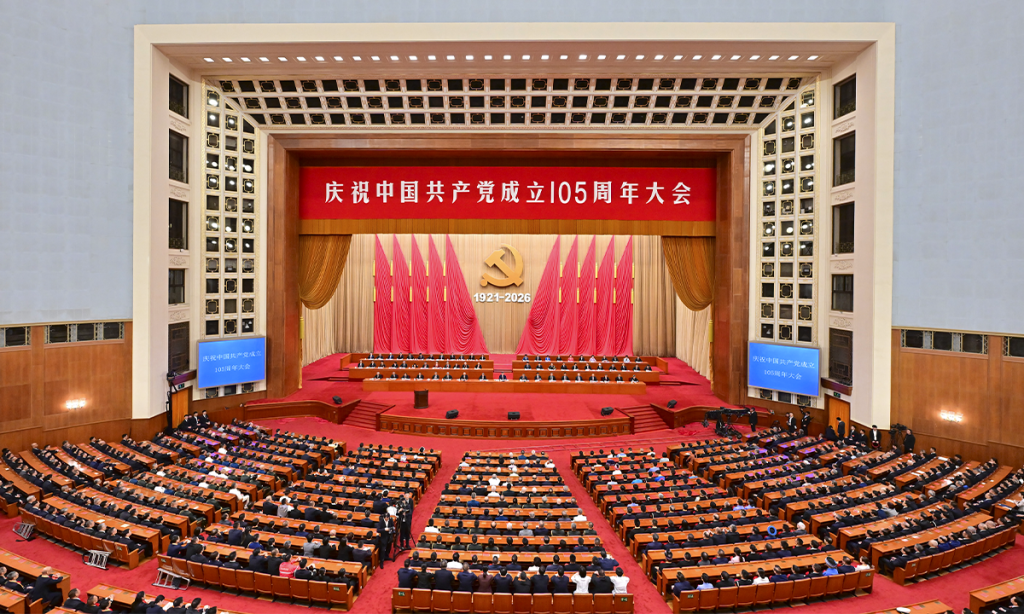
Chinese President Xi Jinping on Wednesday hailed the 105-year history of the Communist Party of China (CPC) as the "most magnificent epic" of the Chinese nation and urged the Party to press ahead to build China into a modern socialist country on schedule.
Addressing a gathering marking the CPC's 105th founding anniversary, Xi, also general secretary of the CPC Central Committee and chairman of the Central Military Commission, called on Party members to remain steadfast in their convictions and work tirelessly to fulfill the Party's missions in the new era and on the new journey, Xinhua News Agency reported.
Founded in 1921 against the backdrop of a weak China plagued by foreign humiliation and poverty, the CPC has grown from a small group of just over 50 members into the world's largest governing party with tremendous global influence. Xi underscored the importance of meeting the goal of fully realizing socialist modernization by the middle of the century.
"Time stops for no one, and neither does history," he said.
Across China, celebrations were held to mark the anniversary of the CPC's founding. Party members gathered to renew their vows and remember their mission, while many others visited historical memorial halls to pay their respects and learn about the Party's journey.
Epic in millennia-long history
The CPC has led the Chinese people in writing the most magnificent epic in the millennia-long history of the Chinese nation through unremitting endeavors, Xi said at the gathering marking the 105th anniversary of the CPC on Wednesday, Xinhua reported.
The endeavors over the past 105 years have fundamentally transformed the future of the Chinese people, opened up the right path for achieving the great rejuvenation of the Chinese nation, and demonstrated the strong vitality of Marxism, said Xi.
They have also produced a profound influence on the course of world history, and made the CPC a powerful Communist Party, he said.
Xi also stressed upholding the absolute Party leadership over the people's armed forces. He urged efforts to achieve the goals for the centenary of the People's Liberation Army in 2027 and elevate the people's armed forces to world-class standards at a faster pace.
Resolving the Taiwan question and realizing China's complete reunification is a historic mission and an unshakable commitment for the CPC, Xi said on Wednesday. He pledged resolute actions to fight secessionists seeking "Taiwan independence," oppose external interference, and advance national reunification.
President Xi's speech comprehensively answers three fundamental questions about the CPC's 105-year history: what it has accomplished, why it has succeeded, and how it has advanced its cause. It highlights the Party's role in transforming China and influencing the world, attributes its achievements to its distinctive qualities and explains that its success has been driven by a scientific approach to governance, Xin Ming, a professor from the School of Marxism at Beihang University, told the Global Times on Wednesday.
Together, these arguments present the Party's defining character, explain why the CPC has succeeded, and reaffirm its determination to continue along its chosen path, Xin said. He added that it is especially important at this critical juncture to strengthen confidence in the country's future development and maintain strategic resolve across society.
At the gathering on Wednesday, Xi also conferred the July 1 Medal, the Party's highest honor, on model CPC members at the Great Hall of the People in central Beijing on Wednesday morning.
Across China, various events were held to celebrate the anniversary. The Museum of the Communist Party of China in Beijing launched a series of special exhibitions showcasing the Party's history and the enduring spirit that shaped its development. A Global Times reporter on Wednesday witnessed streams of visitors visiting the museum to experience the exhibitions and revisit the Party's history.
"Visiting the museum today, on the Party's birthday, feels especially meaningful. Witnessing probationary members take their official oaths reminds me once again of the honor and responsibility of being a CPC member," said 73-year-old Gao Jilie.
"I brought my granddaughter so she can learn about the Party's history and traditions from an early age. Today she is a Young Pioneer, but in the future, she may join the Party, which is a lifelong journey of growth and commitment. I hope this visit helps us reflect on our history, carry forward our revolutionary heritage, and find inspiration for the future," Gao added.
Meanwhile, in Shanghai, the Memorial Hall of the First National Congress of the CPC also drew large crowds despite the rain. Among the visitors was Yan Weiyong, who joined the Communist Party of China in 1976 and has made the site an annual destination for decades.
Seeing so many visitors today, including children, reflects the Party's deep roots among the people and gives me confidence that its mission will endure, Yan said, noting that over the past 105 years, China has transformed from a poor nation into an important force for world peace and development. Amid profound global changes unseen in a century, China's stability and development path can offer valuable lessons for humanity's future.
Wider recognition
Chinese Foreign Ministry spokesperson Guo Jiakun said at a press briefing on Wednesday that political parties, leaders and people of various sectors from many countries have expressed congratulations in one way or another on the 105th anniversary of the founding of the CPC. They spoke highly of how the CPC has always put the people front and center, taken solid effort to rejuvenate the nation, constantly improved itself, led the Chinese people in making great achievements in economic and social progress, and made important contribution to world peace and development.
The Central Committee of the Communist Party of Vietnam (CPV) has sent a congratulatory message. In the message, the CPV Central Committee congratulated the CPC on its achievements over the past 105 years in uniting and leading the Chinese people to overcome numerous difficulties and challenges and secure remarkable accomplishments, according to the Vietnam News.
President of Belarus Aleksandr Lukashenko also sent greetings to President Xi on the 105th anniversary of the CPC founding. Lukashenko noted the special importance of Chinese initiatives in the fields of global development, security, civilization and governance, according to Belarus Today.
While the founding of the CPC was historically hailed as an epoch-making milestone for the nation, today it must be viewed through the lens of world history. Under the Party's leadership, China's rapid rise has profoundly reshaped the global landscape, Yang Xuedong, director of the Department of Political Sciences at Tsinghua University, told the Global Times.
Xin said that under the leadership of the CPC, China has engineered a development miracle that defies traditional Western political theories by successfully pioneering modernization and shattering the myth that modernization equals Westernization. This historic rise proves that when China does well, the world does better.
Today, a strong China is also actively translating its domestic success into Chinese wisdom, offering new models for human advancement and practical solutions to global challenges, the expert said.
An article published by the Herald in Zimbabwe recently noted that the 105th anniversary of the CPC is a rare and resonant milestone in modern statecraft.
"The CPC's journey is a testament that a people, guided by a strong and visionary party, can overcome any obstacle to build a nation that commands respect on the world stage… The CPC's 105th anniversary is therefore not just a Chinese celebration but a milestone for global solidarity. It represents a commitment to multilateralism and a vision of a world where the Global South can rise together," read the article.
The China National Space Administration (CNSA) announced on Tuesday that China will establish a coordinated ground- and space-based monitoring system for near-Earth asteroids to provide early warning and monitoring support for planetary defense against potential asteroid impacts, China Central Television (CCTV) News reported on Tuesday.
The risk of near-Earth asteroid impacts is regarded as a potential threat and a common challenge facing all humanity. According to the United Nations, June 30 is observed each year as International Asteroid Day.
According to CCTV's coverage, as a responsible major spacefaring nation, China is advancing plans for its asteroid defense system. Effective planetary defense requires early warning, with integrated ground- and space-based monitoring network at the core.
As of June 2026, more than 40,000 near-Earth asteroids had been discovered and catalogued globally. Although none has been confirmed to be on a definite collision course with Earth, many smaller celestial bodies have yet to be detected. According to CCTV, China has made initial breakthroughs in early-warning models and algorithms for asteroid impact risks, and is developing an operational near-Earth asteroid risk warning system.
Following the detection of a potentially hazardous asteroid, the next step is determining how to deflect it. Song Zhongping, a military affairs and aerospace technology expert, told the Global Times on Tuesday that one of the most straightforward approaches is kinetic impact, in which a spacecraft or missile collides with the asteroid to alter its trajectory or break it into smaller fragments, thereby reducing the overall threat.
Song said another set of approaches focuses on changing the asteroid's orbit. These include gravity tractors, laser ablation and continuous-thrust techniques, with the ultimate goal of nudging the asteroid away from Earth's orbital path well in advance, preventing a potential impact.
Wu Weiren, Chief designer of China's Lunar Exploration Program, said that China plans to carry out a kinetic impact test on an asteroid tens of millions of kilometers away around 2027, with the aim of altering its orbit. The mission will also conduct in-orbit assessments to evaluate the effectiveness of the impact, according to a report posted by CNSA, citing the Science and Technology Daily.
Song said with the capabilities, technological expertise and resources to advance such efforts, China is contributing to global planetary defense and the shared goal of safeguarding humanity from potential asteroid threats.