Crocs take a bite out of claims of ancient stone-tool use

Recent reports of African and North American animal fossils bearing stone-tool marks from being butchered a remarkably long time ago may be a crock. Make that a croc.

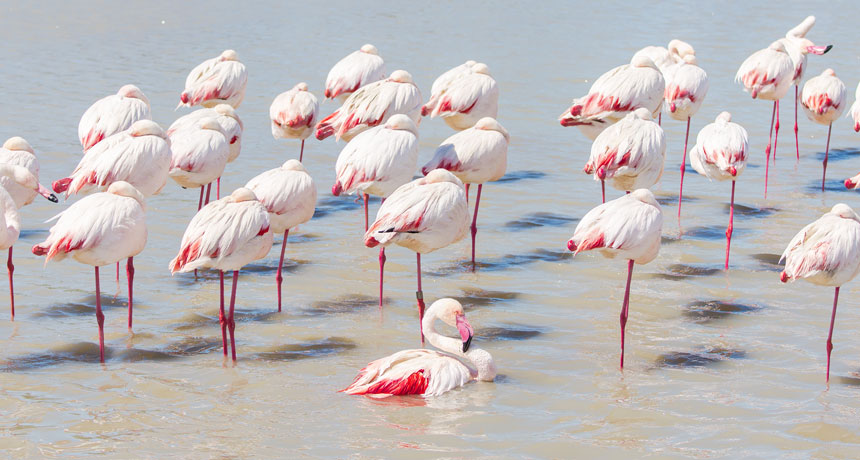
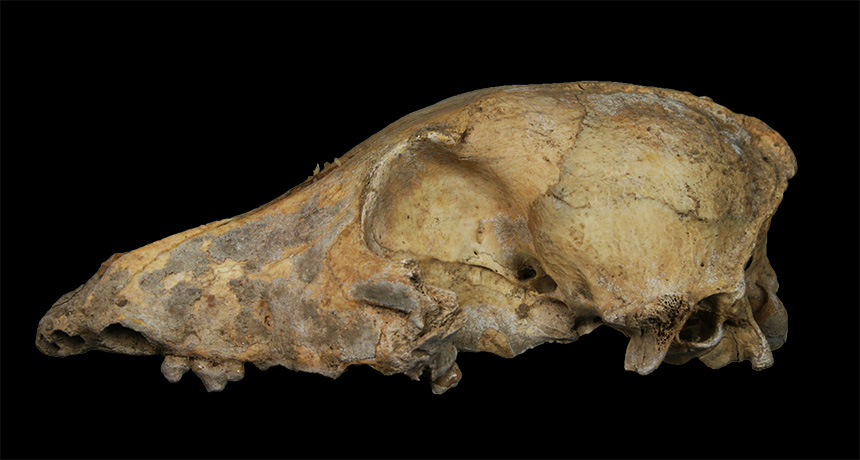
Crocodile bites damage animal bones in virtually the same ways that stone tools do, say paleoanthropologist Yonatan Sahle of the University of Tübingen in Germany and his colleagues. Animal bones allegedly cut up for meat around 3.4 million years ago in East Africa (SN: 9/11/10, p. 8) and around 130,000 years ago in what’s now California (SN: 5/27/17, p. 7) come from lakeside and coastal areas. Those are places where crocodiles could have wreaked damage now mistaken for butchery, the scientists report online the week of November 6 in the Proceedings of the National Academy of Sciences.
Larger samples of animal fossils, including complete bones from various parts of the body, are needed to begin to tease apart the types of damage caused by stone tools, crocodile bites and trampling of bones by living animals, Sahle’s team concludes. “More experimental work on bone damage caused by big, hungry crocs is also critical,” says coauthor Tim White, a paleoanthropologist at the University of California, Berkeley.

In a field where researchers reap big rewards for publishing media-grabbing results in high-profile journals, such evidence could rein in temptations to over-interpret results, says archaeologist David Braun of George Washington University in Washington, D.C., who did not participate in the new study or the two earlier ones. “There’s a push to publish extraordinary findings, but evolutionary researchers always have to weigh what’s interesting versus what’s correct.”

Authors of the ancient butchery papers agree that bone marks made by crocodiles deserve closer study and careful comparison with proposed stone-tool marks. But the researchers stand their ground on their original conclusions.

Microscopic investigations in the 1980s led some researchers to conclude that carnivores such as hyenas leave U-shaped marks on bones. In contrast, they argued, stone tools leave V-shaped incisions with internal ridges. And hammering stones create signature pits and striations.
Sahle’s group expanded on research previously conducted by paleoanthropologist Jackson Njau of Indiana University Bloomington. In his 2006 doctoral dissertation, Njau reported that bone damage produced by feeding crocodiles looks much like stone-tool incisions and pits, with a few distinctive twists such as deep scratches. Njau retrieved and studied cow and goat bones from carcasses that had been eaten by crocodiles housed at two animal farms in Tanzania.

In the new study, the scientists used Njau’s findings to reassess marks on fossils previously excavated in Ethiopia and dating to around 4.2 million, 3.4 million and 2.5 million years ago. Damage to these fossils has generally been attributed to butchery with stone tools.

Incisions and pits on arm bones from an ancient hominid, Australopithecus anamensis, and similar marks on a horse’s leg bone likely resulted from crocodile bites and not stone-tool use, as initially suspected, the investigators say. If stone tools had indeed damaged the A. anamensis remains, that would raise the possibility of cannibalism — a difficult behavior to confirm with fossils. Tellingly, Sahle’s team argues, these bones come from what were once waterside areas. Some were found in the same sediment layer as crocodile remains. Marks on these bones include deep scratches consistent with crocodile bites.

The horse fossil comes from a spot along an ancient lakeshore where no stone tools have been found, a further clue in favor of damage from croc bites.

Jagged pits, incisions and other marks scar a leg fragment and lower jaw from an ancient hoofed animal. But microscopic analyses could not definitively attribute the damage to stone tools or crocodile bites.

In light of these findings, the ancient California and 3.4-million-year-old East Africa bones should also be reexamined with the possibility of croc damage in mind, White says. For now, the earliest confirmed stone-tool marks occur on animal bones from two East African sites dating to around 2.5 million years ago (SN: 4/17/04, p. 254), he adds.

The range of crocodile marks described in the new study doesn’t look “especially like” damage to the 130,000-year-old mastodon bones on California’s coast, says paleontologist Daniel Fisher of the University of Michigan in Ann Arbor, a coauthor of the ancient California bones paper. No fossil evidence indicates crocodiles lived there at that time, he adds. Several lines of evidence, including pounding marks and damage near joints, point to stone-tool use at the West Coast site, says archaeologist Richard Fullagar of the University of Wollongong in Australia, also a coauthor of the mastodon paper.

Further studies of the 3.4-million-year-old African bones previously reported as probable examples of animal butchery will statistically compare the probability of various causes for particular marks, including crocodile bites, says Shannon McPherron, the lead author of the earlier study and an archaeologist at the Max Planck Institute for Evolutionary Anthropology in Leipzig, Germany. In that way, researchers can assess whether any one cause stands out as the strongest candidate.

Seeds coated in a common pesticide might affect birds’ migration

MINNEAPOLIS — Pesticides that kill insects can also have short-term effects on seed-eating birds. Ingesting even small amounts of imidacloprid, a common neonicotinoid pesticide, can disorient migratory white-crowned sparrows, researchers report.

Neonicotinoid pesticides were designed to be safer than traditional pesticides: toxic to insects, but comparatively harmless to other animals. But the new findings add to evidence suggesting that the widely used pesticides, which are chemically similar to nicotine, might be sending ecological ripples beyond the intended targets.
In lab studies, researchers captured wild white-crowned sparrows, Zonotrichia leucophrys, that were migrating north and fed them small doses of imidacloprid for three days — the amount that birds would get from eating a few pesticide-coated wheat seeds. The birds that ate the pesticides lost weight, study coauthor Margaret Eng reported November 15 at the annual meeting of the Society of Environmental Toxicology and Chemistry North America.

And when placed in a large, inverted funnel used to study birds’ migratory orientations, the neonic-fed birds tried to fly in directions other than north. Birds that consumed sunflower oil instead showed no ill effects.

For the birds that ate pesticides, the damage was temporary — after two weeks, the birds regained normal function and body weight, Eng, a toxicologist at the University of Saskatchewan in Saskatoon, Canada, and her colleagues also reported November 9 in Scientific Reports.

The fact that the effects reverse after a period of time is “good news,” says Thomas Bean, a toxicologist at the University of Maryland in College Park who wasn’t part of the study. The short-term malaise might incentivize birds to avoid that food in the future. Bean has found that Japanese quail, Coturnix japonica, also show similar temporary behavioral effects in response to neonicotinoids.
Preliminary results from field studies also appear to confirm the published lab findings. Eng’s team outfitted white-crowned sparrows in the wild with tiny tracking tags. The scientists gave the birds small amounts of pesticides, held the birds for six hours, and then released them.

When released, the birds still had traces of the chemicals in their blood plasma, the researchers reported at the November meeting. On average, there wasn’t a difference between groups in how long the birds hung around before resuming migration, but all of the birds that waited an abnormally long time had eaten neonics. Those animals’ flight paths also appeared to be slightly skewed from the route favored by the control birds.

Those analyses are preliminary, cautions Eng, and a closer look at the data could change the story.

First pedestrian death from a self-driving car fuels safety debate

The first known pedestrian fatality involving a fully autonomous self-driving car will most likely raise questions about the vehicles’ safety.

But “until we know what happened, we can’t really know what this incident means” for the future of self-driving vehicles, says Philip Koopman, a robotics safety expert at Carnegie Mellon University in Pittsburgh. Only when we know more about the crash, including details on the actions of the pedestrian as well as data logs from the car, can we make judgments, he says.
The incident took place late Sunday night when a self-driving car operated by Uber hit and, ultimately, killed a woman crossing the street in Tempe, Ariz. Early reports indicate that a human safety driver was at the wheel, and the car was in autonomous mode. In response, Uber has suspended testing of its fleet of self-driving cars in Tempe and other cities across the nation. The National Transportation Safety Board is investigating, the New York Times reports.

The NTSB has previously conducted an investigation into the 2016 death of a man who was driving a partly autonomous Tesla, concluding that the driver ignored multiple safety warnings.

Self-driving cars already face high levels of mistrust from other motorists and potential passengers. In a AAA survey in 2017, 85 percent of baby boomers and 73 percent of millennials reported being afraid to ride in self-driving cars (SN Online: 11/21/17).

It is widely accepted by experts such as Koopman that autonomous cars will eventually be safer drivers than the average person, because the vehicles don’t get distracted, among other things. But proving that safety may be time-consuming. A 2016 study by Nidhi Kalra, an information scientist at the RAND Corporation in San Francisco, found that self-driving cars might have to drive on roads for decades to statistically prove their superior safety.
When — or if — self-driving cars are proven safer than human drivers, the vehicles will still have to contend with other questions, such as whether to take steps to protect passengers or pedestrians in a collision (SN: 12/24/16, p. 34).

This spinning moon shows where debris from giant impacts fell

THE WOODLANDS, Texas — A new map of flat, light-colored streaks and splotches on the moon links the features to a few large impacts that spread debris all over the surface. The finding suggests that some of the moon’s history might need rethinking.

Planetary scientist Heather Meyer, now at the Lunar and Planetary Institute in Houston, used data from NASA’s Lunar Reconnaissance Orbiter to make the map, the most detailed global look at these light plains yet. Previous maps had been patched together from different sets of observations, which made it hard to be sure that features that looked like plains actually were.
Astronomers originally assumed that the light plains were ancient lava flows from volcanoes. But rocks brought back from one of these plains by Apollo 16 astronauts in 1972 did not have volcanic compositions. That finding led some scientists to suspect the plains, which cover about 9.5 percent of the lunar surface, came from giant impacts.

Meyer’s map supports the impact idea. Most of the plains, which are visible across the whole moon, seem to originate from debris spewed from the Orientale basin, a 930-kilometer-wide bowl in the moon’s southern hemisphere that formed about 3.8 billion years ago.
“It looks like there’s just a giant splat mark,” Meyer says. About 70 percent of the lunar plains come from either Orientale or one other similar basin, she reported March 22 at the Lunar and Planetary Science Conference. “What this is telling us,” she says, “is these large basins modified the entire lunar surface at some point.”
The map also shows that some small impact craters up to 2,000 kilometers from Orientale have been filled in with plains material. That’s potentially problematic, because planetary scientists use the number of small impact craters to estimate the age of the lunar surface. If small craters have been erased by an impact half a moon away, that could mean some of the surface is older than it looks, potentially changing scientists’ interpretations of the moon’s history (SN: 6/11/16, p. 10).

A Chinese space station will fall to Earth this weekend

China’s first space station, Tiangong-1, is expected to fall to Earth sometime between March 31 and April 1. No fooling.

Most of the 10.4-meter-long station will burn up as it zooms through Earth’s atmosphere. But some parts will survive and reach the ground, according to the European Space Agency’s Space Debris Office. No one can be sure where or when those pieces will hit. Even within hours of the station reaching the atmosphere, the final hit zone predictions will cover thousands of kilometers. ESA predicts that any latitude between 42.8° N (so as far north as Chicago) and 42.8° S (down to Tasmania) is fair game. The geometry of the station’s orbit means that the edges of that zone are more likely to be hit than the equator.
Much of that area is oceans or uninhabited. “The personal probability of being hit by a piece of debris from Tiangong-1 is actually 10 million times smaller than the yearly chance of being hit by lightning,” according to ESA. (If you’re wondering, the annual chance of getting zapped in the United States is 1 in 1,083,000.)
Launched in 2011, Tiangong-1 — which means Heavenly Palace — was visited twice by Chinese astronauts, in 2012 and in 2013. The craft was supposed to last only two years, and China put it into sleep mode after the second visit to prepare to steer it back to Earth for a controlled reentry. But in March 2016, the Chinese space agency announced that they had lost contact with the craft and expected it to reenter the atmosphere sometime in 2017
Reentry is unlikely to be dangerous, but it will look cool. The disintegrating space station will blaze through the sky like a fireball. ESA and the Chinese space agency are running daily updates on the station’s location, so check back to see if it will be visible where you are.

Toxic chemicals turn a new material from porous to protective

PHOENIX — A new, breathable material that can also block biological or chemical threats could offer comfortable protection for people working in contaminated environments or dangerous military zones.

The bottom layer of the material, described April 3 at the Materials Research Society spring meeting, features carbon nanotube pores embedded within a flexible synthetic polymer film. These pores are just a few nanometers across — too small for bacterial or viral cells to squeeze through, but wide enough for sweat to escape.
The top layer offers further protection. It is made of another, spongy polymer that normally allows water and other molecules to pass through. But when the polymer comes into contact with G-series nerve agents — the family of toxic chemicals that includes sarin gas — it flattens into a dense sheet that seals over the carbon nanopores underneath. The polymer can be restored to its original state by soaking it in a high-pH chemical broth.

Both layers together are still less than half the thickness of a sheet of paper, and could be laid over fabrics without putting the wearer at risk of overheating. That’s an improvement over the typical protective gear that’s permanently sealed against contaminants, said study coauthor Francesco Fornasiero, a chemical engineer at Lawrence Livermore National Laboratory in California.

In early testing, the material completely blocked out dengue virus cells, as well as 90 percent of the chemical diethyl chlorophosphate, used as a stand-in for toxic nerve agents. The researchers are working to make the material even more impervious to dangerous chemicals, Fornasiero said.

This ancient lizard may have watched the world through four eyes

About 50 million years ago, a monitor lizard in what is now Wyoming perceived the world through four eyes. Saniwa ensidens is the only known jawed vertebrate to have had two eyelike photosensory structures at the top of the head, in addition to the organs we commonly think of as eyes, researchers report April 2 in Current Biology.

The structures are called the pineal and parapineal organs. Among animals alive today, only the jawless fish called a lamprey has both structures. But many modern reptiles have a so-called third eye, the pineal organ.
The researchers examined fossils collected 150 years ago by Yale University students. Scans of the fossils using a technique called X-ray computed tomography revealed spaces in the skull for both the third and fourth eye.

What the ancient lizard did with these organs isn’t known, but some modern vertebrates use the amplified photosensitivity they glean from the pineal glands to navigate. S. ensidens may have been able to perceive polarized light and use the angle of the sun like a compass, as some modern lizards do. Or it may have navigated using Earth’s magnetic field, much like some amphibians and migratory birds.

This plastic can be recycled over and over and over again

There’s a great future in plastics.

A new kind of plastic can, when exposed to the right chemicals, break down into the same basic building blocks that it came from and be rebuilt again and again. The recyclable material is more durable than previous attempts to create reusable plastics, researchers report inthe April 27 Science.

Designing plastics that can be easily reused is one line of attack against the global plastic waste problem. Only about 10 percent of plastic ever made gets recycled, according to a 2017 study in Science Advances. But the material is so cheap and useful that hundreds of millions of tons of it keeps getting churned out each year.
A major impediment to plastic recycling is that most plastics degrade into molecules that aren’t immediately useful. Transforming those molecules back into plastic or into some other product requires many chemical reactions, which makes the recycling process less efficient. And while biodegradable plastics have become popular in recent years, they break down only if the right microbes are present. More often than not, these plastics end up lingering in landfills or floating in the ocean. Creating plastics that could be broken down into their building blocks and reused without additional processing and purifying could help reduce the pollution buildup.

But designing such a plastic polymer is a balancing act, says Michael Shaver, a polymer chemist at the University of Edinburgh who wasn’t part of the study. Polymers are long chains of small molecules, called monomers, that link together like beads on a string. Monomers that need extreme temperatures or too much chemical coaxing to join up into polymers might not be practical building blocks. And resulting polymers need to be stable up to a high enough temperature that, say, pouring hot coffee into a cup made of them won’t destabilize the chains and make the plastic melt into a sticky puddle.
Polymer chemist Jianbo Zhu and his colleagues at Colorado State University in Fort Collins set out to solve this challenge. The team had had some luck in the past creating a polymer that could be broken down into its starting molecules. But the resulting plastics created by their lab and others on the same track were too soft and temperature-sensitive to have much practical use.
This time, Zhu and his colleagues modified one of their previous creations, a small ringed molecule, by adding another ring in a way that braced the molecule into a particular conformation. That rigidity helped the monomers quickly link together at room temperature into polymer chains that are heat-stable.
Then, when exposed to certain mild chemicals or high enough heat, the polymers degraded back into monomers. The researchers were able to repeat this cycle several times, showing that, in theory, the polymer could be infinitely recyclable.

While each monomer is locked into a particular conformation, not all of them have the same shape even though they’re made from the same chemical recipe. Mixing two different conformations of monomers created an even stronger plastic, says Zhu.

“This is probably the best system out there,” Shaver says.

Still, it’s not perfect yet: Zhu and his colleagues plan to tinker with the monomer design more in the future to make the resulting plastic a bit less brittle. Eventually, they hope to commercialize the product.

Synthetic opioids involved in more deaths than prescription opioids

As opioid-related deaths rise in the United States, so has the role of synthetic opioids — primarily illicit fentanyl, mixed into heroin or made into counterfeit pills (SN Online: 3/29/18). In 2016, synthetics surged past prescription opioids and were involved in 19,413 deaths, compared with 17,087 deaths involving prescription opioids, researchers report May 1 in JAMA. The study is based on data from the National Vital Statistic System’s record of all U.S. deaths.

“Synthetic opioids are much deadlier than prescription opioids,” says emergency physician Leana Wen, Health Commissioner of Baltimore, who was not involved in the study. Fentanyl, for example, is about 50 to 100 times more potent than morphine. The illicit origins of many synthetic opioids make the public health response more difficult, she says. “We can track prescriptions; it’s much harder to track illegally trafficked drugs.”

Defenseless moths do flying impressions of scary bees and wasps

Clearwing moths may not look all that dangerous, despite having largely see-through wings like bees and wasps. But some fly like fierce insects best left well alone.

Four clearwing species from Southeast Asian rainforests aren’t perfect mimics of local bees and wasps. Yet the resemblance looked much stronger when entomologist Marta Skowron Volponi of the University of Gdansk in Poland and her husband, nature filmmaker Paolo Volponi, spent days at a time poised with a video camera on riverbanks to capture the flight patterns. Four clearwing species occasionally showed up, including a shaggy Aschistophleps that turned out to be a species new to science.

That newly named A. argentifasciata and two other species flew in slow, zigzaggy paths that resembled the meanderings of local stingless bees. (This kind of bee is not great for snacking birds because it bites fiercely.) Another clearwing moth flew distinctly faster with broader turning sweeps instead of zigzags, much like a wasp.

Behaving like something that stings or bites may be an advantage for moths that forgo the cover of night and fly in daylight with its abundance of hungry birds and other predators that hunt by sight. Even imperfect body mimics get convincing in the air, Skowron Volponi and her colleagues report May 2 in Biology Letters.