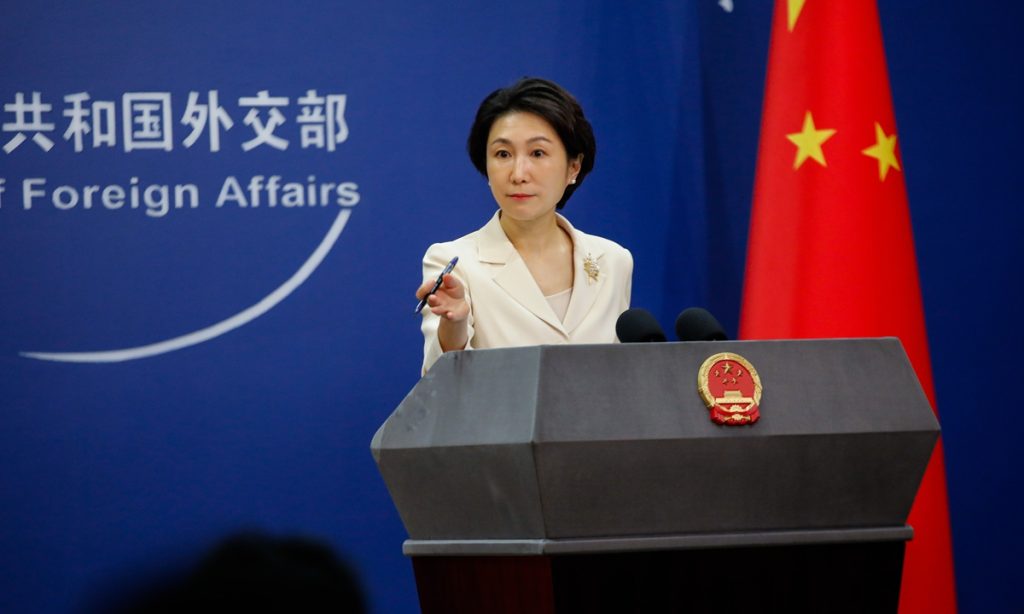
In pursuit of selfish political interests, the Taiwan regional Democratic Progressive Party (DPP) authorities have gone so far as to sell out the overall interests of the Chinese nation, betray their ancestry and abandon all bottom lines. This once again exposes that "Taiwan independence" forces have completely lost their national standpoint and degenerated into out-and-out scum of the nation. They will surely be spurned by compatriots on both sides of the Taiwan Straits and reckoned by history, Chinese Foreign Ministry spokesperson Mao Ning said on Tuesday.
Mao made the remarks when asked to comment that on May 31, in response to the Foreign Ministry spokesperson's earlier response on Japan and the Philippines announcing the launch of so-called maritime delimitation talks, the Taiwan regional authorities' so-called "external affairs" department issued comments expressing approval of the move by Japan and the Philippines and questioning the mainland's sovereign rights in the relevant waters.
Mao said that China has already stated its position on Japan and the Philippines' announcement of the launch of maritime delimitation talks. I would like to reiterate that the area the two countries announced they will delimit is east of China's Taiwan island. According to China's domestic law and international law including UNCLOS, China has exclusive economic zone and continental shelf in this area.
Under the UNCLOS, the delimitation of the exclusive economic zone and continental shelf between states with opposite or adjacent coasts shall be effected by agreement on the basis of the principle of equity.
Any delimitation talks involving waters east of Taiwan island must include Chinese side's participation. Japan and the Philippines' launch of so-called maritime delimitation talks while bypassing China seriously violates international law, including the UNCLOS, and the basic norms governing international relations, and seriously infringes on China's maritime rights and interests. China will never allow this, Mao said.
Both sides of the Taiwan Straits belong to one China. Safeguarding national territorial sovereignty and maritime rights and interests is the common responsibility of all Chinese people on both sides of the Straits, said Mao.
In May, Beijing's Longtan Central Park was full of fresh vitality. The trees had turned lush green, and a light breeze rippled across the lake. Early-morning exercisers moved slowly through their Tai Chi routines, while joggers circled the path at an easy rhythm, blending into the lush spring scene. On an island in the lake, the main event of the 2026 National Nutrition Week was underway, this year centered on the theme "Nutrition at the Family Table." The goal was to bring healthy eating into everyday homes, with crowds drifting between booths to pick up practical tips on improving their diets.
Among the exhibits, Zespri, the New Zealand-based kiwifruit marketer, drew some of the liveliest activity. Children, eyes wide, tossed small balls representing vitamin C, dietary fiber, and potassium into bowls, turning the concept of "high nutrient density" into a game. Nearby, younger visitors scanned QR codes for the brand's "Diet for Good" AI-powered diet mini-program, uploading photos of recent meals and receiving instant analyses of calories, nutritional gaps, and suggestions for better combinations. Zhao Boya, a young nutrition professional, had just tried all the interactive stations. "People used to focus on whether they were full," she told Global Times. "Now they want to know exactly what's in their food and how to balance it. It's a shift from eating enough to eating well."
A spirited 64-year-old retiree worked her way through every interactive station, laughing as she described her own daily routine: breakfast at her house was more likely to be coarse grains and fresh fruit than fried dough sticks or steamed buns, supplemented with protein powder and vitamins when needed. She said this kind of game-like education felt far more approachable than flipping through dense textbooks.
After finishing the fun, knowledge-filled experiences, each participant received a plump, fresh SunGold kiwifruit. The retiree posed happily for a selfie, the fruit held up like a trophy. Against the backdrop of China's deepening Healthy China Initiative, public awareness of health is rising fast. Consumers are moving beyond simply wanting more choices toward demanding higher quality, paying closer attention to nutritional content, sourcing, safety, and overall health value.
So what can a kiwifruit from New Zealand - with its natural nutritional strengths and Zespri's long-term commitment to the Chinese market - contribute to better-balanced meals for Chinese families, and to a healthier nation as a whole?
Refreshed global platform
At the Zespri booth, a robot named "Kiwi Brothers" stopped pedestrians in their tracks. The interaction was simple: visitors listed what they had eaten for their previous meal, and the robot analyzed it against the "Balanced Meal Plate," a model promoted by the Chinese Nutrition Society based on The Chinese Dietary Guidelines. A scientifically sound plate, the guidelines state, should contain four parts: grains and tubers, animal-based foods or soy products, vegetables, and fruits. Based on the input, the robot offered straightforward feedback.
Light as the game seemed, it turned an otherwise abstract question into something concrete: What did I actually eat last meal? Was my plate all grains and meat? Did I get enough fruit, vegetables and fiber?
A parent confessed, "The hardest part is dealing with a picky eater who won't touch fruit. I worry she's not getting enough vitamins." A group of young adults, by contrast, focused on sugar control, calorie management and lighter eating. Fitness enthusiasts naturally wondered which fruit delivers efficient energy with high nutritional density.
This rising public awareness is mirrored at the national policy level. In recent years, China's National Health Commission and other authorities have rolled out landmark frameworks including the Healthy China Action and the National Nutrition Plan (2017-30). The policies aim to widely spread dietary nutrition knowledge, issue tailored dietary guidelines for different age and social groups, guide the public toward scientific eating habits, and foster a broader culture of balanced nutrition. From top-level national strategy to everyday family dining tables, balanced eating has evolved into a core priority in China's public health agenda.
Yet, a significant gap remains between policy frameworks and daily reality. Data released by the Chinese Nutrition Society reveals a stark paradox: more than half of the population faces nutritional imbalance, marked by energy excess alongside micronutrient deficiencies. Some 63.6 percent of residents exceed the recommended fat-to-energy ratio of 30 percent. Meanwhile, 76.4 percent and 81.9 percent fall short of recommended vitamin C and potassium intake, respectively, with dietary fiber, calcium, and B vitamins consistently below recommended levels.
"Currently, consumers are far more involved than ever," Kok Hwee Ng, Chief Marketing Officer of Zespri International, told the Global Times. "They see health and nutrition not as a solution when you fall sick, but as something they want to integrate into their everyday life." This shift, Ng noted, has reshaped expectations of premium brands. "When consumers choose a premium product, they naturally expect superior quality, taste, and nutritional value," she said. "But in an increasingly volatile world, they are asking for more. They want brands to play a bigger role in improving their lives, the well-being of their families, their communities, and their future."
That expectation arrives as 2026 marks the official launch of Zespri's decade-long strategic roadmap: its 2035 ambition to become the world's healthiest fruit brand. Central to this vision is the rollout of its refreshed global platform, Grown for Good.
At its core, Grown for Good places natural nutrition at the center of every decision, from orchard cultivation to marketing initiatives and value creation.
Ng believes Zespri is uniquely positioned to lead this charge. "As the world's leading fruit brand, built around one of the most nutrient-dense fruits in the produce aisle, we have both the right and the responsibility to help societies become healthier," she said.
The mission extends beyond the fruit itself. By promoting nutritional literacy and championing the value of natural nutrition, Ng sees a path to unlocking shared value. "It's about creating a cycle where consumers gain health, society gains knowledge, and our growers gain the stability to continue producing high-quality fruit," she added. "That is the essence of Grown for Good - delivering lasting value for people and the planet."
From orchard to table
The SunGold kiwifruit handed to visitors at the end of the interactive games in Longtan Central Park looked simple enough - fresh, plump and ready to eat. For many participants, it was a small reward after a round of nutrition games.
Behind that small reward was a much longer journey.
Before it appeared at the booth, it had already traveled through a chain of growers, standards, cold-chain transport and digital tools linking New Zealand orchards with Chinese dining tables.
Ng said the complete industrial chain is one of the features that makes the brand special. "What makes Zespri even more special is its complete industrial chain layout. The brand is jointly owned by nearly 3,000 local growers in New Zealand, and we take natural nutrition as the core driving force of the whole industrial chain operation," she said. This chain includes dry matter testing in New Zealand orchards, scientific maturity control, cross-border temperature-controlled cold-chain logistics and digital traceability. These steps support the fruit's journey from orchard to dining table, before it appears in the everyday scenes already visible at the booth: in a child's hand, in a family's breakfast, or as part of a balanced plate.
The emphasis on standards is also connected with the way nutrient density was presented during the event. The report released at the National Nutrition Week advocated high-quality diets and greater intake of high-nutrient-dense foods. Event materials described kiwifruit as a representative high-nutrient-density fruit rich in vitamin C, potassium and dietary fiber; 100 grams of SunGold kiwifruit provides 171 milligrams of vitamin C, meeting the adult daily requirement of 100 milligrams.
The other end of the "orchard to table" route was not a supermarket shelf, but a phone screen. The "Diet for Good" mini-program, which had already drawn visitors to scan and test their own meals at the booth, uses AI image recognition to analyze meals and show users their structure, calorie level and key nutrient information.
The mini-program is supported by professional content from the "National Nutrition Literacy Promotion Program " under the Nutrition Literacy Branch of the Chinese Association of Health Promotion and Education , and combines that content with technologies including Volcano Engine and the Doubao large model. The platform also supports continued meal records and trend tracking, helping users move from a single meal check to a longer-term view of their diet structure. Ng linked the AI-powered balanced plate activity to a gap between willingness and daily action.
"It's not that people don't want to keep a healthy diet, it's just hard to carry it out in busy daily life. So we're finding simple ways to make healthy eating easier, guide subtle behavior changes and remind consumers to make conscious dietary choices," she said.
"The AI-powered platforms we newly launched this year make it easier for people to stick to healthy eating habits in the long run, because balanced nutrition intake needs long-term persistence, and progress comes from small daily changes," Ng said.
Zespri's partnership with the Chinese Nutrition Society dates back to 2021, when the two sides jointly released their first white paper focusing on working women's diet and health.
The Global Times learned that cooperation has since extended to reports on food nutrient density, visualized food-selection tools and participation in national nutrition events. Ng said the company sees its work in China not merely as selling products, but as contributing to the well-being of Chinese communities.
Toward a healthy China
The family table is also where long-term eating habits begin. That is why Zespri's work in China has extended beyond product promotion into children's food education, parent guidance and hospital-based nutrition programs.
One example is the "Nutrition & Dietary Knowledge Standard Course Program," a children's food education standardization program, supported by Zespri China and launched by the China Association for Student Nutrition and Health Promotion in 2023.
Research from the Chinese Center for Disease Control and Prevention shows that 76.21 percent of children consume less than 60 percent of the recommended daily intake of fresh vegetables, while 85.21 percent consume less than 60 percent of the recommended intake of fresh fruit.
The Global Times learned that, over the past three years, the "Nutrition & Dietary Knowledge Standard Course Program" has covered 35 cities, nearly 2,000 schools and more than 300 communities, benefiting 1.5 million students and families. Ng said the focus on schools is linked to the importance of forming eating habits early. She noted that good eating behaviors, nutritional knowledge and dietary habits take shape from a young age, while changing dietary habits in adulthood is much more difficult.
Hospitals are another setting for nutrition education. The "Sunshine Education & Healthy Growth Program," supported by professional partners including the Children's Hospital of Fudan University, extends nutrition guidance into medical settings and provides scientific support for children and families.
Ng said hospital cooperation helps guide children to develop good eating habits and gather scientific evidence on balanced diets and fresh fruit intake, especially nutrient-dense fruits. She also said cooperation with industry experts can support the building of scientific guidance systems for dietary nutrition.
Looking ahead, Ng said Zespri will continue to deepen cooperation with institutions including the Chinese Nutrition Society and the China Association for Student Nutrition and Health Promotion, bringing nutrition education to more cities and more scenarios.
In that sense, the small kiwifruit becomes part of a bigger story - not only about what people buy, but about how healthier habits take root, one household at a time. At the family table, even one more piece of fruit can quietly echo China's broader pursuit of better health for all.
Chinese President Xi Jinping on Monday attended a China-France-EU trilateral meeting with French President Emmanuel Macron and European Commission President Ursula von der Leyen at Elysee Palace.
Named Long Chenchen, or the "dragon of Chenchen," the mascot for China's upcoming Dragon Spring Festival Gala has been released, with a lot of design details showing the aesthetics of Chinese cultural elements.
To celebrate 2024, which will be the Year of the Dragon in Chinese culture, "Long Chenchen" has been designed as a cute yet lively dragon, colored orange and red and with a pair of doll eyes.
The seemingly cute-looking dragon takes inspiration from Chinese archaeological discoveries. The design of its nose was inspired by a dragon shaped jade item that was discovered in the Erlitou Ruins, a major site in Luoyang, Central China's Henan province that witnessed the rise and fall of the Xia (c.2070BC-c.1600BC) and Shang (c.1600BC-1046BC) dynasties.
The fire shape pattern on its shoulder was inspired by a bronze piece with cloud patterns that dates back to the Spring and Autumn Period (770BC-476BC).
The bronze piece has 12 vividly depicted dragon sculptures, showing ancient Chinese creativity as well as skill for handicrafts.
Another source of inspiration was a gilded dragon sculpture that is currently in the Xi'an Museum.
The dragon mascot has been praised by netizens on China's social media platforms such as Sina Weibo. Some said Chenchen looks "amiable" and can bring more international visitors to see the profound yet adorable Chinese culture.
"I like this cartoon version of a dragon, as it is amiable and friendly. Those characteristics also represent the modern China," a netizen posted on Sina Weibo.
Despite receiving many likes, the mascot has also sparked criticism. It has four claws, some of which have five toes and others have three. This made some netizens speculate the dragon character might have been synthesized by artificial intelligence.
"The Spring Festival Gala is the gala of the year for all of us in China. It deserves a professional team to design a character for it," one netizen wrote.
On Thursday morning, China Media Group (CMG), the media platform that is going to be in charge of the gala, officially declared on Sina Weibo that the dragon mascot was created entirely by human beings but not AI.
Admitting that it has some "imperfections," CMG said that it was created by designers "one stroke after another." All the details about the dragon, including its patterns, colors and face have been revised by designers through many versions.
Along with such verbal explanations, a short video showing the design team working on the mascot has been posted on Sina Weibo by CMG. The media group's response to the character's design has become a trending topic on Sina Weibo and has been viewed by more than 200 million netizens.
"Whether it was created by AI or human beings, I think the mascot has successfully delivered the spirit of the dragon. The dragon is important to show the life-force of Chinese culture," one netizen posted on Sina Weibo.
Sichuan is experiencing light rain as Wu Lian walks on her way to work. Meanwhile, the earthworms emerging from the muddy ground along the road are also undergoing a migration.
However, some earthworms are getting stranded on the cement pavement. At moments like these, Wu Lian picks them up one by one and places them back into the soil, despite her hands getting covered in mud.
"Otherwise, they could easily be stepped on by passersby," she says. This unique habit stems from her trip to Lhasa, capital of the Xizang Autonomous Region, three years ago.
This "Earthworm Rescue Operation" is a very unique manifestation of the spirit of cherishing and protecting life that the Tibetan people have continued for centuries.
Near the Potala Palace, in the vicinity of Zong Juelu Kang (Dragon King Pond), during the rainy season, you can see people of all ages bending down to gently pick up earthworms that haven't been able to complete their journey and placing them back onto the grass.
This is because once the sun comes out in Lhasa, the worms quickly lose moisture and face danger. Some local children even take the initiative to inform unaware tourists to watch their step. Of course, this isn't just about rescuing earthworms; it's just that because earthworms are particularly fragile and inconspicuous, such a scene arises.
Even today, many Tibetan people still recite a protective mantra when drinking water, intending to liberate the microorganisms in the water about to be consumed. And they will tell their grandchildren the story of this small ritual like a tale.
Similar to how the Han people usually call for compassion for even the tiniest of ants, Tibetans start from rescuing earthworms. This custom originates from the core doctrine of "equality of all sentient beings" in Tibetan Buddhism.
Carried on to the present day, it can be said that rather than merely being a religious tradition, it has long been internalized as a guiding principle in the daily lives of ordinary people.
Another story is about the origin of the Shoton Festival. Before the 17th century, the Shoton Festival was a primitive religious celebration.
According to folk tradition, as the weather warmed in the summer and all living things revived, monks going out for activities would inadvertently harm living creatures, violating the precept of "do not kill."
Therefore, the Gelug sect's monastic rules stipulated that from the fourth to the sixth month of the Tibetan calendar, monks could only recite scriptures and practice in the temples.
On the day the ban was lifted, monks would leave the temples and descend from the mountains. To thank the monks, local residents would prepare yogurt and organize outings and feasts, including traditional Tibetan opera performances, to celebrate the occasion.
It can be said that the practice of loving and protecting life is the starting point of the socialization process for Tibetan children. Life is adorable, life is respectable.
Tibetans believe that one should do everything possible to avoid harming any life. If there is truly no choice, then one should still hold an attitude of respect and gratitude.
Such beliefs permeate through people's daily lives, in the cycles of seasons, and in their daily activities.
The fundamental principle that every newborn baby first learns is a profound empathy toward the existence of any life. As an extension of this spirit, Tibetans often exhibit the utmost compassion toward the weak.
The essence of compassion includes, but is not limited to, "tolerance." Its broader meaning encompasses acknowledgment, empathy, and an emotionally driven commitment to action.
In Xizang, during feasts, not only were beggars not driven away, but they were also treated as honored guests.
Even in contemporary urban life, Tibetans are still able to treat all members of society more equally. On this land, the quality of being "snobbish" is disliked by everyone.
Faith is not confined to temples but also ingrained in everyday activities. When we talk about culture, it is never limited to external forms like singing, dancing, or intricate artwork.
The local people's outlook on life has gradually extended beyond the region with the opening up of Xizang.
Therefore, when you hear tourists from other regions or countries expressing admiration for how Tibetan culture has purified their souls, it is likely not an exaggeration.
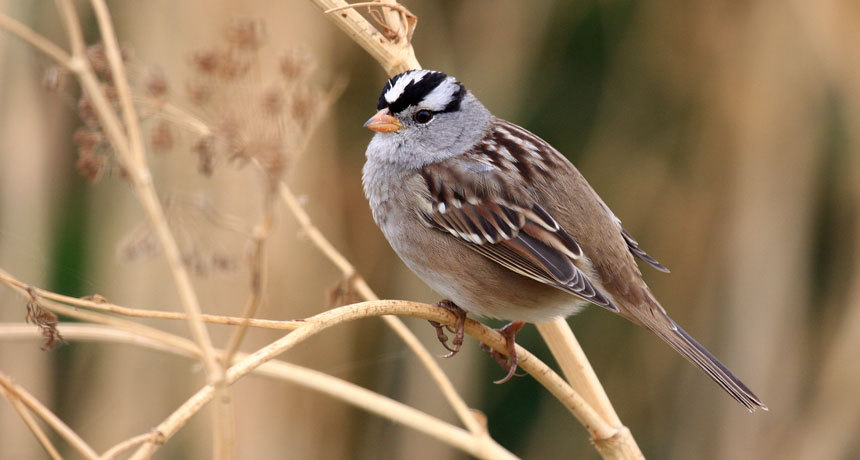
MINNEAPOLIS — Pesticides that kill insects can also have short-term effects on seed-eating birds. Ingesting even small amounts of imidacloprid, a common neonicotinoid pesticide, can disorient migratory white-crowned sparrows, researchers report.
Neonicotinoid pesticides were designed to be safer than traditional pesticides: toxic to insects, but comparatively harmless to other animals. But the new findings add to evidence suggesting that the widely used pesticides, which are chemically similar to nicotine, might be sending ecological ripples beyond the intended targets. In lab studies, researchers captured wild white-crowned sparrows, Zonotrichia leucophrys, that were migrating north and fed them small doses of imidacloprid for three days — the amount that birds would get from eating a few pesticide-coated wheat seeds. The birds that ate the pesticides lost weight, study coauthor Margaret Eng reported November 15 at the annual meeting of the Society of Environmental Toxicology and Chemistry North America.
And when placed in a large, inverted funnel used to study birds’ migratory orientations, the neonic-fed birds tried to fly in directions other than north. Birds that consumed sunflower oil instead showed no ill effects.
For the birds that ate pesticides, the damage was temporary — after two weeks, the birds regained normal function and body weight, Eng, a toxicologist at the University of Saskatchewan in Saskatoon, Canada, and her colleagues also reported November 9 in Scientific Reports.
The fact that the effects reverse after a period of time is “good news,” says Thomas Bean, a toxicologist at the University of Maryland in College Park who wasn’t part of the study. The short-term malaise might incentivize birds to avoid that food in the future. Bean has found that Japanese quail, Coturnix japonica, also show similar temporary behavioral effects in response to neonicotinoids. Preliminary results from field studies also appear to confirm the published lab findings. Eng’s team outfitted white-crowned sparrows in the wild with tiny tracking tags. The scientists gave the birds small amounts of pesticides, held the birds for six hours, and then released them.
When released, the birds still had traces of the chemicals in their blood plasma, the researchers reported at the November meeting. On average, there wasn’t a difference between groups in how long the birds hung around before resuming migration, but all of the birds that waited an abnormally long time had eaten neonics. Those animals’ flight paths also appeared to be slightly skewed from the route favored by the control birds.
Those analyses are preliminary, cautions Eng, and a closer look at the data could change the story.
The first known pedestrian fatality involving a fully autonomous self-driving car will most likely raise questions about the vehicles’ safety.
But “until we know what happened, we can’t really know what this incident means” for the future of self-driving vehicles, says Philip Koopman, a robotics safety expert at Carnegie Mellon University in Pittsburgh. Only when we know more about the crash, including details on the actions of the pedestrian as well as data logs from the car, can we make judgments, he says. The incident took place late Sunday night when a self-driving car operated by Uber hit and, ultimately, killed a woman crossing the street in Tempe, Ariz. Early reports indicate that a human safety driver was at the wheel, and the car was in autonomous mode. In response, Uber has suspended testing of its fleet of self-driving cars in Tempe and other cities across the nation. The National Transportation Safety Board is investigating, the New York Times reports.
The NTSB has previously conducted an investigation into the 2016 death of a man who was driving a partly autonomous Tesla, concluding that the driver ignored multiple safety warnings.
Self-driving cars already face high levels of mistrust from other motorists and potential passengers. In a AAA survey in 2017, 85 percent of baby boomers and 73 percent of millennials reported being afraid to ride in self-driving cars (SN Online: 11/21/17).
It is widely accepted by experts such as Koopman that autonomous cars will eventually be safer drivers than the average person, because the vehicles don’t get distracted, among other things. But proving that safety may be time-consuming. A 2016 study by Nidhi Kalra, an information scientist at the RAND Corporation in San Francisco, found that self-driving cars might have to drive on roads for decades to statistically prove their superior safety. When — or if — self-driving cars are proven safer than human drivers, the vehicles will still have to contend with other questions, such as whether to take steps to protect passengers or pedestrians in a collision (SN: 12/24/16, p. 34).
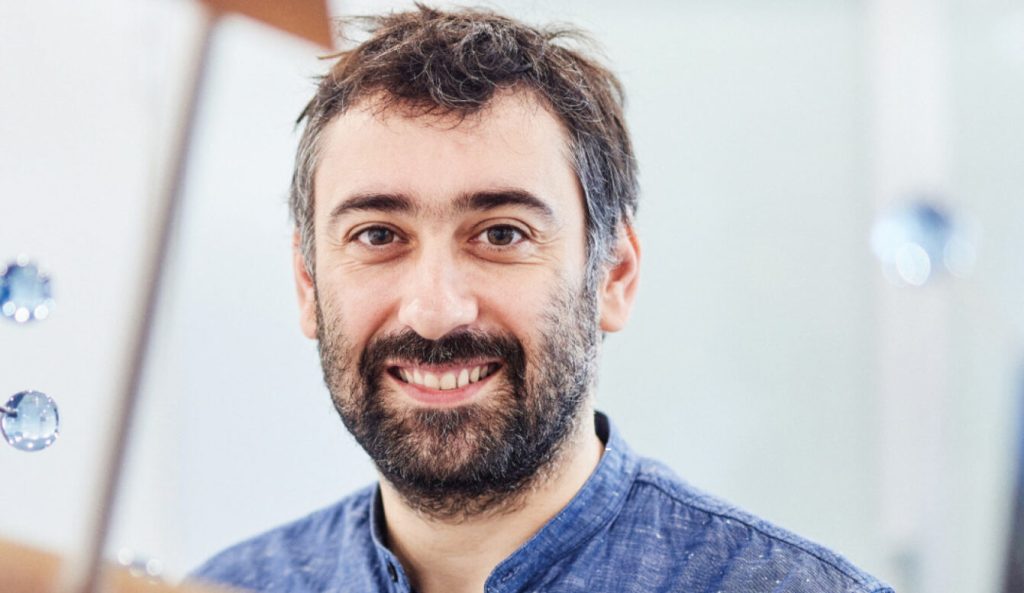
Josep Cornella doesn’t deal in absolutes. While chemists typically draw rigid lines between organic and inorganic chemistry, Cornella, a researcher at Max-Planck-Institut für Kohlenforschung in Mülheim an der Ruhr, Germany, believes in just the opposite.
“You have to be open to cross boundaries,” he says, “and learn from it.” The fringes are “where the rich new things are.”
Cornella is an organic chemist by industry standards; he synthesizes molecules that contain carbon. But he’s put together a team from a wide range of backgrounds: inorganic chemists, physical organic chemists, computational chemists. Together, the team brainstorms novel approaches to designing new catalysts, so that chemical reactions essential to pharmaceuticals and agriculture can be made more efficient and friendly for the environment. Along the way, Cornella has unlocked mysteries that stumped chemists for years.
“He has told us about catalysts … that we didn’t have before, and which were just pipe dreams,” says Hosea Nelson, a chemist at Caltech who has not worked with Cornella. Bold idea When Cornella heard a speaker at a 2014 conference say that bismuth was nontoxic, he was sure it was a mistake. Bismuth is a heavy metal that sits between toxic lead and polonium on the periodic table. But it is indeed relatively nontoxic — it’s even used in the over-the-counter nausea medicine Pepto-Bismol.
Still, bismuth remains poorly understood. That’s one reason it attracted him. “It was a rather forgotten element of the periodic table,” Cornella says. But, “it’s there for a reason.”
Cornella started wondering if an element like bismuth could be trained for use as a catalyst. For the last century, scientists have been using transition metals, like palladium and iron, as the main catalysts in industrial synthesis. “Could we actually train [bismuth] to do what these guys do so well?” he asked. It was a conceptual question that “was completely naïve, or maybe stupid.”
Far from stupid: His team successfully used bismuth as a catalyst to make a carbon-fluorine bond. And bismuth didn’t just mimic a transition metal’s role — it worked better. Only a small amount of bismuth was required, much less than the amount of transition metal needed to complete the same task.
“A lot of people, including myself and other [researchers] around the world, have spent a lot of time thinking about how to make bismuth reactions catalytic,” Nelson says. “He’s the guy who cracked that nut.”
Standout research While the bismuth research is “weird” and “exciting,” Cornella says, it remains a proof of concept. Bismuth, though cheap, is not as abundant as he had hoped, so it’s not a very sustainable option for industry.
But other Cornella team findings are already being used in the real world. In 2019, the group figured out how to make an alternative to Ni(COD)2, a finicky catalyst commonly used by chemists in the lab. If it’s not kept at freezing temperatures and protected from oxygen by a layer of inert gases, the nickel complex falls apart.
The alternative complex, developed by Lukas Nattmann, a Ph.D. student in Cornella’s lab at the time, stays stable in oxygen at room temperature. It’s a game changer: It saves energy and materials, and it’s universal. “You can basically take all those reactions that were developed for 60 years of Ni(COD)2 and basically replace all of them with our catalyst, and it works just fine,” Cornella says. Cornella’s lab is also developing new reagents, substances that transform one material into another. The researchers are looking to transform atoms in functional groups — specific groupings of atoms that behave in specific ways regardless of the molecules they are found in — into other atoms in a single step. Doing these reactions in one step could cut preparation time from two weeks to a day, which would be very useful in the pharmaceutical industry
Taking risks It’s the success that gets attention, but failure is “our daily basis,” Cornella says. “It’s a lot of failure.” As a student, when he couldn’t get a reaction to work, he’d set up a simple reaction called a TBS protection — the kind of reaction that’s impossible to get wrong — to remind himself that he wasn’t “completely useless.”
Today he runs a lab that champions taking risks. He encourages students to learn from one another about areas they know nothing about. For instance, a pure organic chemist could come into Cornella’s lab and leave with a good understanding of organometallic chemistry after spending long days working alongside a colleague who is an expert in that area.
To Cornella, this sharing of knowledge is crucial. “If you tackle a problem from just one unique perspective,” he says, “maybe you’re missing some stuff.”
While Cornella might not like absolutes, Phil Baran, who advised Cornella during his postdoctoral work at Scripps Research in San Diego, sees Cornella as fitting into one of two distinct categories: “There are chemists who do chemistry in order to eat, like it’s a job. And there are chemists who eat in order to do chemistry,” Baran says. Cornella fits into the latter group. “It’s his oxygen.”
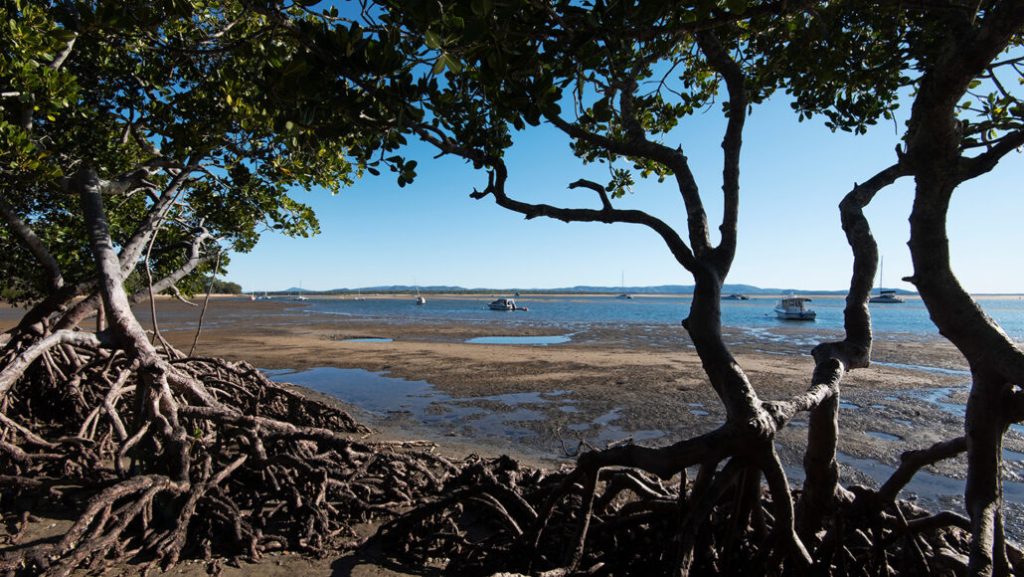
The glossy leaves and branching roots of mangroves are downright eye-catching, and now a study finds that the moon plays a special role in the vigor of these trees.
Long-term tidal cycles set in motion by the moon drive, in large part, the expansion and contraction of mangrove forests in Australia, researchers report in the Sept. 16 Science Advances. This discovery is key to predicting when stands of mangroves, which are good at sequestering carbon and could help fight climate change, are most likely to proliferate (SN: 11/18/21). Such knowledge could inform efforts to protect and restore the forests. Mangroves are coastal trees that provide habitat for fish and buffer against erosion (SN: 9/14/22). But in some places, the forests face a range of threats, including coastal development, pollution and land clearing for agriculture. To get a bird’s-eye view of these forests, Neil Saintilan, an environmental scientist at Macquarie University in Sydney, and his colleagues turned to satellite imagery. Using NASA and U.S. Geological Survey Landsat data from 1987 to 2020, the researchers calculated how the size and density of mangrove forests across Australia changed over time.
After accounting for persistent increases in these trees’ growth — probably due to rising carbon dioxide levels, higher sea levels and increasing air temperatures — Saintilan and his colleagues noticed a curious pattern. Mangrove forests tended to expand and contract in both extent and canopy cover in a predictable manner. “I saw this 18-year oscillation,” Saintilan says.
That regularity got the researchers thinking about the moon. Earth’s nearest celestial neighbor has long been known to help drive the tides, which deliver water and necessary nutrients to mangroves. A rhythm called the lunar nodal cycle could explain the mangroves’ growth pattern, the team hypothesized.
Over the course of 18.6 years, the plane of the moon’s orbit around Earth slowly tips. When the moon’s orbit is the least tilted relative to our planet’s equator, semidiurnal tides — which consist of two high and two low tides each day — tend to have a larger range. That means that in areas that experience semidiurnal tides, higher high tides and lower low tides are generally more likely. The effect is caused by the angle at which the moon tugs gravitationally on the Earth.
Saintilan and his colleagues found that mangrove forests experiencing semidiurnal tides tended to be larger and denser precisely when higher high tides were expected based on the moon’s orbit. The effect even seemed to outweigh other climatic drivers of mangrove growth, such as El Niño conditions. Other regions with mangroves, such as Vietnam and Indonesia, probably experience the same long-term trends, the team suggests.
Having access to data stretching back decades was key to this discovery, Saintilan says. “We’ve never really picked up before some of these longer-term drivers of vegetation dynamics.”
It’s important to recognize this effect on mangrove populations, says Octavio Aburto-Oropeza, a marine ecologist at the Scripps Institution of Oceanography in La Jolla, Calif., who was not involved in the research.
Scientists now know when some mangroves are particularly likely to flourish and should make an extra effort at those times to promote the growth of these carbon-sequestering trees, Aburto-Oropeza says. That might look like added limitations on human activity nearby that could harm the forests, he says. “We should be more proactive.”
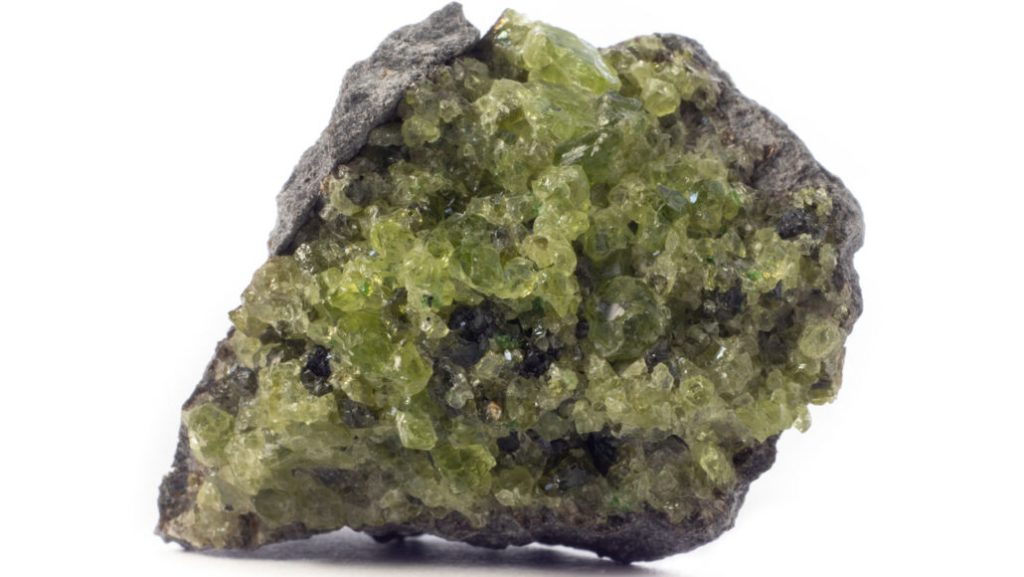
Cocooned within the bowels of the Earth, one mineral’s metamorphosis into another may trigger some of the deepest earthquakes ever detected.
These cryptic tremors — known as deep-focus earthquakes — are a seismic conundrum. They violently rupture at depths greater than 300 kilometers, where intense temperatures and pressures are thought to force rocks to flow smoothly. Now, experiments suggest that those same hellish conditions might also sometimes transform olivine — the primary mineral in Earth’s mantle — into the mineral wadsleyite. This mineral switch-up can destabilize the surrounding rock, enabling earthquakes at otherwise impossible depths, mineral physicist Tomohiro Ohuchi and colleagues report September 15 in Nature Communications. “It’s been a real puzzle for many scientists because earthquakes shouldn’t occur deeper than 300 kilometers,” says Ohuchi, of Ehime University in Matsuyama, Japan.
Deep-focus earthquakes usually occur at subduction zones where tectonic plates made of oceanic crust — rich in olivine — plunge toward the mantle (SN: 1/13/21). Since the quakes’ seismic waves lose strength during their long ascent to the surface, they aren’t typically dangerous. But that doesn’t mean the quakes aren’t sometimes powerful. In 2013, a magnitude 8.3 deep-focus quake struck around 609 kilometers below the Sea of Okhotsk, just off Russia’s eastern coast.
Past studies hinted that unstable olivine crystals could spawn deep quakes. But those studies tested other minerals that were similar in composition to olivine but deform at lower pressures, Ohuchi says, or the experiments didn’t strain samples enough to form faults.
He and his team decided to put olivine itself to the test. To replicate conditions deep underground, the researchers heated and squeezed olivine crystals up to nearly 1100° Celsius and 17 gigapascals. Then the team used a mechanical press to further compress the olivine slowly and monitored the deformation.
From 11 to 17 gigapascals and about 800° to 900° C, the olivine recrystallized into thin layers containing new wadsleyite and smaller olivine grains. The researchers also found tiny faults and recorded bursts of sound waves — indicative of miniature earthquakes. Along subducting tectonic plates, many of these thin layers grow and link to form weak regions in the rock, upon which faults and earthquakes can initiate, the researchers suggest.
“The transformation really wreaks havoc with the [rock’s] mechanical stability,” says geophysicist Pamela Burnley of the University of Nevada, Las Vegas, who was not involved in the research. The findings help confirm that olivine transformations are enabling deep-focus earthquakes, she says.
Next, Ohuchi’s team plans to experiment on olivine at even higher pressures to gain insights into the mineral’s deformation at greater depths.